
34 Binary Fission: Prokaryotic Cell Division

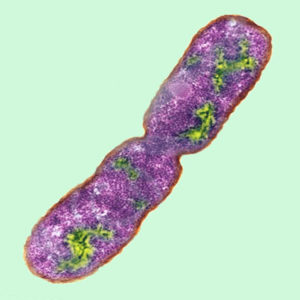
The cell division process of prokaryotes (such as E. coli bacteria) is called binary fission. For unicellular organisms, cell division is the only method to produce new individuals. The outcome of this type of cell reproduction is a pair of daughter cells that are genetically identical to the parent cell. In unicellular organisms, daughter cells are whole individual organisms. This is a less complicated and much quicker process than cell division in eukaryotes. Because of the speed of bacterial cell division, populations of bacteria can grow very rapidly.
Bacteria dividing
Figure 34.1. An E. coli bacteria dividing into two identical daughter cells.
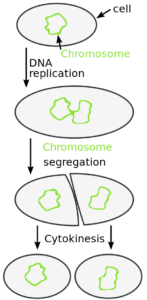
A prokaryotic cell divides into two separate cells in the process of binary fission.
Figure 34.2. Prokaryotic cell division occurs via a process called binary fission.

To achieve the outcome of identical daughter cells, there are some essential steps. The genomic DNA must be replicated (using DNA replication) and then one copy must be moved into each of the daughter cells. The cytoplasmic contents must also be divided to give both new cells the machinery to sustain life. In bacterial cells, the genome consists of a single, circular DNA chromosome; therefore, the process of cell division is very simple.

Video Transcript

Most bacteria reproduce by a process called binary fission.

During binary fission, the parental cell divides to form two daughter cells. In the first step of binary fission, the bacterium replicates, or copies, its chromosome and attaches each identical copy to a separate location on the cell membrane. Unlike eukaryotic cells, bacteria do not need to dissolve a nuclear membrane or assemble a mitotic spindle, making binary fission very quick and efficient.

Second, the cell elongates. Since the chromosomes are attached to different locations on the cell membrane, they separate from one another.

Third, the bacterium pinches off at the center and forms a septum – a separating wall – between the two compartments of the cell.

Finally, the cell splits into two new daughter cells. These daughter cells are fully mature bacteria that can grow and, if conditions are right, continue the binary fission process.

References

Unless otherwise noted, images on this page are licensed under CC-BY 4.0 by OpenStax.

OpenStax, Biology. OpenStax CNX. May 27, 2016. http://cnx.org/contents/s8Hh0oOc@9.10:Vbi92lHB@9/The-Cell-Cycle

OpenStax, Biology. OpenStax CNX. May 27, 2016. http://cnx.org/contents/s8Hh0oOc@9.10:LlKfCy5H@4/Prokaryotic-Cell-Division

License

Icon for the Creative Commons Attribution 4.0 International License

MHCC Biology 112: Biology for Health Professions Copyright © 2019 by Lisa Bartee is licensed under a Creative Commons Attribution 4.0 International License, except where otherwise noted.

Share This Book