94 Hemophilia: a sex-linked disorder
So far, all the genes we have discussed have had two copies present in all individuals. This is because the individual inherited one from the male parent’s haploid gamete and one from the female parent’s haploid gamete. The two gametes came together during fertilization to produce a diploid individual. There is, however, one exception to this: genes which are present on the sex chromosomes.
Video Transcript
Would you like to know one of the most underappreciated pieces of cytoplasm out there?
Platelets.
We take for granted the function of our platelets, which are fragments of cytoplasm that help stop us from bleeding. They help our blood to clot when we get hurt.
But there is a disorder called hemophilia that can affect those platelets and even a basic cut could be dangerous for them because they could bleed continuously.
We have many treatments for the symptoms of Hemophilia now that have greatly improved outcomes with this disorder. Although it wasn’t always that way.
Hemophilia is a sex-linked, recessive trait, which means it is different from basic Mendelian genetic problems. We still use the terms dominant and recessive for alleles – but this time – those alleles are on sex chromosomes. This is the case with sex-linked traits.
What is a sex chromosome? Recall that humans have 46 chromosomes. Chromosomes are made up of DNA and protein. They contain your genes. Well, two of your 46 chromosomes – they are called the sex chromosomes. In a karyotype, it is usually the last two chromosomes that are the sex chromosomes.
The sex chromosomes are called X and Y chromosomes but it has nothing to do with the shape of the chromosome. That’s kind of confusing but please don’t think that Y chromosomes are shaped like a Y and X chromosomes are shaped like a X. That used to always confuse me – that has nothing to do with their name. The reason they got those names is actually kind of interesting so to the Google for that. Everyone has a X chromosome. But if you have another X chromosome – meaning you have two X chromosomes – you are female. And if you have a Y chromosome – meaning you have a X and Y chromosome – you are male.
There are also genetic disorders where you can have extra copies of sex chromosomes but we are not going into that for this clip.
Sex-linked traits are traits that are specifically on the sex chromosomes. Most sex-linked traits tend to be on the X chromosome, because it is larger than the Y chromosome and contains more genes than the Y chromosome. The disorder hemophilia is like this.
We will use the letter “H” to represent an allele for not having hemophilia and a letter “h” to represent an allele for having hemophilia. Hemophilia is a recessive disorder, which is why it is being represented by a lowercase letter h. Only, it must be placed on the sex chromosomes as a superscript. Like an exponent.
Let me explain what I mean by that. A woman that does not have hemophilia could have the genotype XHXH or XHXh.
Because as long as she’s got at least one dominant allele – that dominating allele – will be what shows. So no hemophilia, since again, hemophilia is a recessive disorder. The only way for her to have hemophilia would be the genotype XhXh. Because only when there is no dominant present will that recessive show up, at least in this type of trait.
For a male to not have hemophilia, his genotype would have to be XHY. Notice how I didn’t put anything on the Y chromosome – again, most sex linked traits are on the X chromosome. If he has the genotype XhY, then he has hemophilia. He doesn’t have two X chromosomes, so in this disorder, he either has it or he doesn’t. There is no heterozygous genotype for the male so he cannot be a carrier.
So let’s say two people that do not have hemophilia have children. However, let’s say the woman is a carrier. That means she is heterozygous.
How do you do a sex-linked Punnett square cross for this kind of trait?
Step 1) Identify the genotypes of the parents. So the mother is XHXh. She doesn’t have hemophilia because of the dominant allele present but she is a carrier. The male, if he does not have hemophilia, must be XHY. There’s no other option for him.
Step 2) Place one parent on the top, outside of the square like this. Place the other parent on the left, outside of the square, like this.
Step 3) Cross them!
For formatting purposes, place X chromosomes before Y. You also write any sex chromosomes with dominant letters first.
The results you get in the squares would be the offspring – the babies.
The genotype ratio could be written out like this.
The phenotype ratio – remember that these are the traits – can be written out that there is a 75% chance that a child will be born without hemophilia and a 25% chance that a child would have hemophilia, for this boy here.
Notice that in this type of example of a sex linked recessive disorder – boys are more likely to inherit this disorder – because they only have one X chromosome. This is true for many other sex linked recessive disorders, such as color blindness.
Well that’s it for the Amoeba Sisters and we remind you to stay curious!
In humans, as well as in many other animals and some plants, the sex of the individual is determined by sex chromosomes – one pair of non-homologous chromosomes. Until now, we have only considered inheritance patterns among non-sex chromosomes, or autosomes. In addition to 22 homologous pairs of autosomes, human females have a homologous pair of X chromosomes, whereas human males have an XY chromosome pair. Although the Y chromosome contains a small region of similarity to the X chromosome so that they can pair during meiosis, the Y chromosome is much shorter and contains fewer genes. When a gene being examined is present on the X, but not the Y, chromosome, it is X-linked.
The X chromosome is one of two sex chromosomes. Humans and most mammals have two sex chromosomes, the X and Y. Females have two X chromosomes in their cells, while males have X and Y chromosomes in their cells. Egg cells all contain an X chromosome, while sperm cells contain an X or a Y chromosome. This arrangement means that during fertilization, it is the male that determines the sex of the offspring since the female can only give an X chromosome to the offspring.
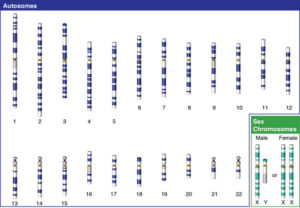
Figure 94.1 Image Description
The X chromosome is one of two sex chromosomes. Humans and most mammals have two sex chromosomes, the X and Y. Females have two X chromosomes in their cells, while males have X and Y chromosomes in their cells. Egg cells all contain an X chromosome, while sperm cells contain an X or a Y chromosome. This arrangement means that during fertilization, it is the male that determines the sex of the offspring.
Most sex-linked genes are present on the X chromosome simply because it is much larger than the Y chromosome. The X chromosome spans about 155 million DNA base pairs and represents approximately 5 percent of the total DNA in cells. The X chromosome likely contains 800 to 900 genes. In contrast, the Y chromosome has approximately 59 million base pairs and only 50-60 genes. Sex is determined by the SRY gene, which is located on the Y chromosome and is responsible for the development of a fetus into a male. This means that the presence of a Y chromosome is what causes a fetus to develop as male. Other genes on the Y chromosome are important for male fertility.
Hemophilia is a bleeding disorder that slows the blood clotting process. People with this condition experience prolonged bleeding or oozing following an injury, surgery, or having a tooth pulled. In severe cases of hemophilia, continuous bleeding occurs after minor trauma or even in the absence of injury (spontaneous bleeding). Serious complications can result from bleeding into the joints, muscles, brain, or other internal organs. Milder forms of hemophilia do not necessarily involve spontaneous bleeding, and the condition may not become apparent until abnormal bleeding occurs following surgery or a serious injury.
The major types of this condition are hemophilia A (also known as classic hemophilia or factor VIII deficiency) and hemophilia B (also known as Christmas disease or factor IX deficiency). Although the two types have very similar signs and symptoms, they are caused by mutations in different genes.
Hemophilia A and hemophilia B are inherited in an X-linked recessive pattern. The genes associated with these conditions are located on the X chromosome, which is one of the two sex chromosomes. In males (who have only one X chromosome), one altered copy of the gene in each cell is sufficient to cause the condition. In females (who have two X chromosomes), a mutation would have to occur in both copies of the gene to cause the disorder. Because it is unlikely that females will have two altered copies of this gene, it is very rare for females to have hemophilia. A characteristic of X-linked inheritance is that fathers cannot pass X-linked traits to their sons.
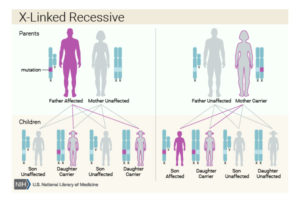
Figure 94.2 Image Description
A diagram shows X-linked recessive inheritance. In the first panel, the male parent is shaded purple and there is a mutation marked on his X chromosome and no mutation marked on his Y chromosome. The female parent is gray and has no mutations marked on either X chromosome. These two parents could produce four possible children. The first is a son who inherited an unmutated X chromosome from the female parent and the unmutated Y chromosome from the male parent. The second is a daughter who is a carrier and is shaded half purple. She inherited an unmutated X chromosome from the female parent and the mutated X chromosome from the male parent. The third is a son who inherited an unmutated X chromosome from the female parent and the unmutated Y chromosome from the male parent. The fourth is a daughter who is a carrier and is shaded half purple. She inherited an unmutated X chromosome from the female parent and the mutated X chromosome from the male parent.
In the second panel, the male parent is shaded gray and there are no mutations marked on either the X or the Y chromosome. The female parent is a carrier and is shaded half purple. She has a mutation marked on one of her X chromosomes. These two parents could produce four possible children. The first is a son who is shaded purple because he is affected. He inherited a mutated X chromosome from the female parent and the unmutated Y chromosome from the male parent. The second is a daughter who is a carrier and is shaded half purple. She inherited a mutated X chromosome from the female parent and an unmutated X chromosome from the male parent. The third is a son who is unaffected because he inherited an unmutated X chromosome from the female parent and the unmutated Y chromosome from the male parent. The fourth is a daughter who is unaffected because she inherited the unmutated X chromosome from the female parent and an unmutated X chromosome from the male parent.
In X-linked recessive inheritance, a female with one altered copy of the gene in each cell is called a carrier. Carrier females have about half the usual amount of coagulation factor VIII or coagulation factor IX, which is generally enough for normal blood clotting. However, about 10 percent of carrier females have less than half the normal amount of one of these coagulation factors; these individuals are at risk for abnormal bleeding, particularly after an injury, surgery, or tooth extraction.
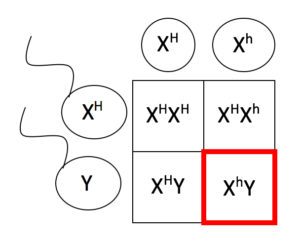
Figure 94.3 Image Description
A Punnett square is shown illustrating a cross between a carrier female (XHXh) and a normal male (XHY). Above each column is a circle representing an egg. One egg is labeled XH (X big H) and the second is labeled Xh (X little h). Next to each row are circles with tails representing sperm. One sperm is labeled XH (X big H) and the second is labeled with a Y for the Y chromosome which does not contain the H gene. The first offspring has the genotype XHXH. The second has the genotype XHXh. The third has the genotype XHY. The fourth is surrounded by a red box and has the genotype XhY.
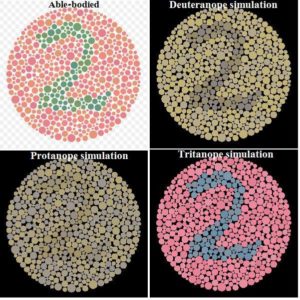
Colorblindness is another example of a sex-linked trait in humans. The genes that produce the photopigments necessary for color vision are located on the X chromosome. If one of these genes is not functional because it contains a harmful mutation, the individual will be colorblind. Men are much more likely than women to be colorblind: up to 100 times more men than women have various types of colorblindness.

Determining Sex Isn’t That Simple
For the purposes of solving Punnett Square problems, we will assume that males are XY and females are XX. However, it is not nearly that simple in real life. You will not be tested on the material in this video, but I highly recommend it because it’s fascinating.
This topic is also discussed in this article in Scientific American: https://www.scientificamerican.com/article/sex-redefined-the-idea-of-2-sexes-is-overly-simplistic1/
References
Unless otherwise noted, images on this page are licensed under CC-BY 4.0 by OpenStax.
OpenStax, Biology. OpenStax CNX. May 27, 2016. http://cnx.org/contents/s8Hh0oOc@9.10:zLLYW2hj@5/Extensions-of-the-Laws-of-Inhe
“X chromosome” by Genetics Home Reference: Your Guide to Understanding Genetic Conditions, National Institutes of Health: U.S. National Library of Medicine is in the Public Domain.
“Y chromosome” by Genetics Home Reference: Your Guide to Understanding Genetic Conditions, National Institutes of Health: U.S. National Library of Medicine is in the Public Domain.
“Hemophilia” by Genetics Home Reference: Your Guide to Understanding Genetic Conditions, National Institutes of Health: U.S. National Library of Medicine is in the Public Domain.