14 Lipids

Lipids are a diverse group of compounds that are united by a common feature. Lipids are hydrophobic (“water-fearing”), or insoluble in water. Lipids perform many different functions in a cell. Cells store energy for long-term use in the form of lipids called fats. Lipids also provide insulation from the environment for plants and animals. For example, they help keep aquatic birds and mammals dry because of their water-repelling nature. Lipids are also the building blocks of many hormones and are an important constituent of the plasma membrane. Lipids include fats, oils, waxes, phospholipids, and steroids.

An otter.
Figure 14.1. The otter’s coat has lipids that are water repelling.

Fats and Oils

A fat molecule consists of two main components—glycerol and fatty acids. Glycerol is an organic compound (an alcohol) that contains three carbons, five hydrogens, and three hydroxyl (OH) groups (Figure 14.2). Fatty acids have a long chain of hydrocarbons to which a carboxyl group is attached, hence the name “fatty acid.” The number of carbons in the fatty acid may range from 4 to 36; most common are those containing 12–18 carbons. In a fat molecule, the fatty acids are attached to each of the three carbons of the glycerol molecule with a covalent bond. This molecule is called a triglyceride.
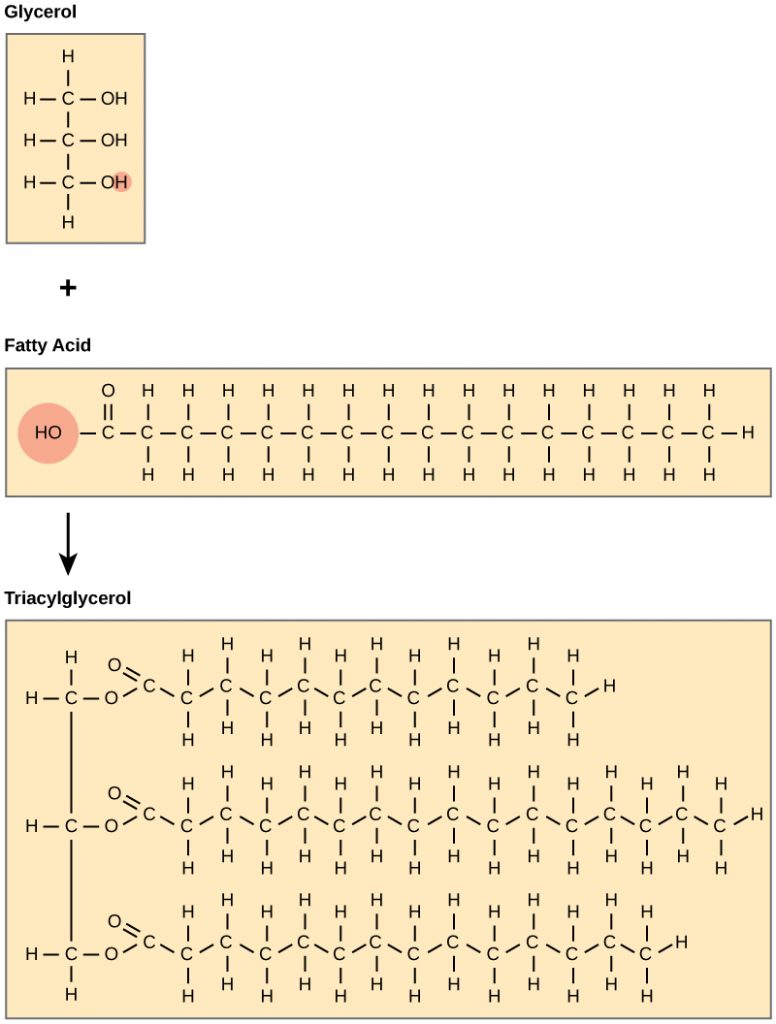
Chemical structures of glycerol, fatty acid, and triacylglycerol.
Figure 14.2. Triacylglycerol is formed by the joining of three fatty acids to a glycerol backbone in a dehydration reaction (remember this removes a water molecule and forms a covalent bond). Three molecules of water are released in the process.

Waxes

Wax covers the feathers of some aquatic birds and the leaf surfaces of some plants. Because of the hydrophobic nature of waxes, they prevent water from sticking on the surface (Figure 14.3). Waxes are made up of long fatty acid chains covalently bonded to long-chain alcohols.
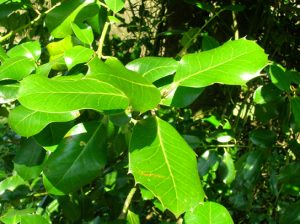
shiny leaves
Figure 14.3. Waxy coverings on some leaves are made of lipids. (credit: Roger Griffith)

Phospholipids

Phospholipids are major constituents of the plasma membrane, the outermost layer of animal cells. Like fats, they are composed of fatty acid chains covalently bonded to a glycerol or sphingosine backbone. Instead of three fatty acids attached as in triglycerides, however, there are two fatty acids forming diacylglycerol, and the third carbon of the glycerol backbone is occupied by a modified phosphate group (Figure 14.4). Phosphatidylcholine and phosphatidylserine are two important phospholipids that are found in plasma membranes.
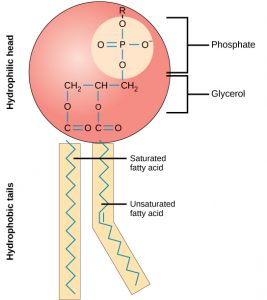
Illustrated phospholipid.
Figure 14.4. A phospholipid is a molecule with two fatty acids and a modified phosphate group attached to a glycerol backbone. The phosphate may be modified by the addition of charged or polar chemical groups. Two chemical groups that may modify the phosphate, choline and serine, are shown here. Both choline and serine attach to the phosphate group at the position labeled R via the hydroxyl group indicated in green.
Figure 14.4 Image Description

Illustrated phospholipid. A round red ball is at the top of the image representing the hydrophilic head. Connected to the bottom of the circle are two yellow rectangles representing the fatty acids (hydrophobic tails).

A phospholipid is an amphipathicmolecule, meaning it has a hydrophobic and a hydrophilic part. The fatty acid chains are hydrophobic and cannot interact with water, whereas the phosphate-containing group is hydrophilic and interacts with water (Figure 14.5). The head is the hydrophilic part, and the tail contains the hydrophobic fatty acids. In a membrane, a bilayer of phospholipids forms the matrix of the structure, the fatty acid tails of phospholipids face inside, away from water, whereas the phosphate group faces the outside, aqueous side. This forms a hydrophobic layer on the inside of the bilayer, where the tails are located.
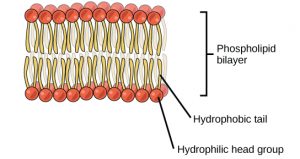
The phospholipid bilayer.
Figure 14.5. The phospholipid bilayer is the major component of all cellular membranes. The hydrophilic head groups of the phospholipids face the aqueous solution. The hydrophobic tails are sequestered in the middle of the bilayer.
Figure 14.5 Image Description

An illustration of the phospholipid bilayer. Two layers of phospholipids are represented as red circles (hydrophilic heads) with two yellow lines (hydrophobic tails) connected to the bottom. From top to bottom, there is a layer of red circles, yellow tails, a small space, then another layer of yellow tails with red circles below that.

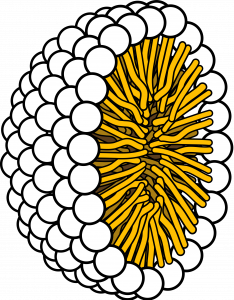
Phospholipids are responsible for the dynamic nature of the plasma membrane. If a drop of phospholipids is placed in water, it spontaneously forms a structure known as a micelle, where the hydrophilic phosphate heads face the outside and the fatty acids face the interior of this structure (Figure 14.6).

Illustration of a micelle. A half a sphere made up of small white circles. Pointing inwards are yellow lines representing the hydrophobic tails.
Figure 14.6. A micelle may be the very early precursor of a cell. It is a single layer of phospholipids that form spontaneously. (credit: AmitWo, Wikimedia)
Figure 14.6 Image Description

Illustration of a micelle. A sphere is made up of phospholipids with the hydrophilic heads represented as white circles and the hydrophobic tails represented as wavy yellow lines. The outside of the sphere is made up of the hydrophilic heads. The sphere has one section cut away showing the inside, where the hydrophobic tails are all pointing towards the center of the sphere.

Steroids

Unlike the phospholipids and fats discussed earlier, steroids have a fused ring structure. Although they do not resemble the other lipids, they are grouped with them because they are also hydrophobic and insoluble in water. All steroids have four linked carbon rings and several of them, like cholesterol, have a short tail (Figure 14.7). Many steroids also have the –OH functional group, which puts them in the alcohol classification (sterols). Remember that each line in these diagrams of chemical structures represents a covalent bond. The points where the lines connect to each other show the location of carbon atoms – these carbon atoms are not labeled, but their existence is implied in the chemical structure.
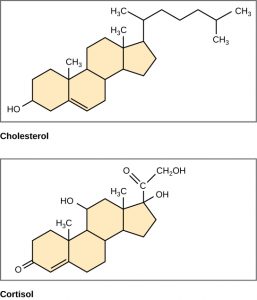
Chemical structures of cholesterol and cortisol.
Figure 14.7. Steroids such as cholesterol and cortisol are composed of four fused hydrocarbon rings.

Cholesterol is the most common steroid. Cholesterol is mainly synthesized in the liver and is the precursor to many steroid hormones such as testosterone and estradiol, which are secreted by the gonads and endocrine glands. It is also the precursor to Vitamin D. Cholesterol is also the precursor of bile salts, which help in the emulsification of fats and their subsequent absorption by cells. Although cholesterol is often spoken of in negative terms by lay people, it is necessary for proper functioning of the body. It is a component of the plasma membrane of animal cells and is found within the phospholipid bilayer. Being the outermost structure in animal cells, the plasma membrane is responsible for the transport of materials and cellular recognition and it is involved in cell-to-cell communication.

How does lipid structure relate to function?

Fats (triglycerides) are made up of three fatty acid hydrocarbon chains connected to a glycerol. Fatty acid chains contain large numbers of carbon-carbon and carbon-hydrogen bonds – they are typically made up of between 4 and 28 carbons connected together in a chain. Just like the carbon-carbon and carbon-hydrogen bonds in glucose allow that molecule to store energy, the bonds in fatty acids allow triglycerides to store energy. In fact, triglycerides can store much more energy than carbohydrates because they contain so many more bonds! This is why fats contain more calories (a measure of energy) than sugars do.

Waxes function to provide a waterproof coating on a surface. Because they are hydrophobic, they can form a coating that repels water.

The structure of phospholipids is very important to their function. Because they are amphipathic (have a hydrophobic and a hydrophilic portion), they self-assemble into structures where the hydrophobic tails are hidden away from the watery environment. This gives the cell membrane a structure that prevents many molecules from moving through it.

Cholesterol is also amphipathic. It can insert into cell membranes in a manner similar to phospholipids. The presence of cholesterol within a membrane prevents the phospholipid tails from packing together tightly. This allows the membrane to remain fluid at lower temperatures.

Video Transcript

Lipids
Lipids are a group of hydrophobic biomolecules that play important roles in living organisms. While the primary function of lipids is long-term energy storage, lipids are also used for protection, insulation, and lubrication. They also act as precursors for some hormones, and are a key component of cell membranes.
Lipid Groups
There are four basic groups of lipids. These are triglycerides, phospholipids, steroids, and waxes. Although these groups differ in many respects, they all have one characteristic in common: They are all insoluble in water.
You may have noticed that lipids and water do not mix. For example, notice the yellow colored oil in the beaker of water shown here? Even if we stirred this for several minutes, or even several hours, the oil would still separate out from the water. This is because lipids are hydrophobic.
From Latin, the prefix “hydro” means “water” and “phobic” means “fear of”. So when you hear that lipids are “hydrophobic”, this basically means that water and lipids do not mix.
Triglycerides
Let’s take a closer look at the category of lipids known as triglycerides. Triglycerides include the fats and oils. Fats (such as lard and butter) are solid at room temperature and are used by animals for insulation, protection and long-term energy storage. Oils (such as corn oil and olive oil) are liquid at room temperature and are used by plants for long-term energy storage.
At the molecular level, triglycerides contain two types of subunit molecules: glycerol and fatty acids. Let’s take a quick look at fatty acids.
A fatty acid has three main parts: a chain of carbon and hydrogen atoms called the “hydrocarbon chain,” a methyl group at one end, and an acid group at the other end. Fatty acids can be either saturated or unsaturated. A fatty acid that has only single carbon to carbon bonds is known as a saturated fatty acid. This is because the carbon chain is “saturated” with all the hydrogen atoms it can hold.
Unsaturated fatty acids have one to several double bonds. Double bonds result in kinks in the fatty acid chain which affects the melting point of the fat. Animal fats have saturated fatty acids and are solid at room temperature while vegetable oils have one or many double bonds and are liquid at room temperature.
A trans-fat is an example of an unsaturated fatty acid where the hydrogen atoms are on opposite sides of the double-bond. Trans-fats are usually formed during the production of processed foods and are also common in partially hydrogenated oils.
In order to increase shelf life and melting point of the fat, excess hydrogen atoms are introduced to an unsaturated oil. This causes the formation of trans-fat bonds in the fatty acid chain. Unfortunately the consumption of trans fats has been associated with cardiovascular disease and its use has fallen from favor.
Now that you understand a little bit about fatty acids, let’s zoom back out and look at how the triglyceride subunits fit together. Remember, a fatty acid is only a small part of a triglyceride. To become a triglyceride, 3 separate fatty acids have to bond with a glycerol molecule through the process of dehydration synthesis.
Phospholipids
Let’s move on to the next category of lipids, which is phospholipids. Phospholipids are similar to triglycerides in that they contain glycerol and two fatty acids. What’s different is that a phosphate group rather than a third fatty is attached to the third carbon of glycerol.
Phospholipids are extremely important, mainly because of their unique properties in regard to water. The phosphate head of the molecule is hydrophilic (or water-loving). This means that it mixes well with water. The fatty acid tails, however, are hydrophobic (or water-hating) and do not mix well with water. Because of these unique properties, phospholipids tend to arrange themselves so that only the hydrophilic heads interact with a watery environment, and the hydrophobic tails crowd inward away from the water. This structure is the major component of plasma membranes of the cell.
Steroids
Steroids are the next category of lipids. Steroids are composed of four fused rings of carbon to which different functional groups are attached. One well-known steroid molecule is cholesterol. Cholesterol serves as a precursor for the synthesis of other steroids such as testosterone, estrogen, vitamin D, and cortisone. Cholesterol is present in plasma membranes where it stabilizes the membrane. The hormones testosterone and estrogen have small differences in their functional groups but large differences on their effects on an organism.
Waxes
Waxes are the final group of lipids. Waxes are non-polar and repel water. They are found in protective coatings on leaves and on outer surfaces of animals. Wax is produced in the ears of some animals to protect the eardrum. In addition, bees construct honey combs from wax.
Now that we’ve covered all four categories of lipids, let’s do a quick recap. The four categories of lipids are triglycerides, phospholipids, steroids and waxes. All lipids are insoluble in water. While the primary function of lipids is long-term energy storage, lipids are also used for a multitude of other purposes, such as protection and insulation, and as a key component of hormones and cell membranes.

References

Unless otherwise noted, images on this page are licensed under CC-BY 4.0 by OpenStax.

OpenStax, Biology. OpenStax CNX. May 27, 2016 http://cnx.org/contents/s8Hh0oOc@9.10:QhGQhr4x@6/Biological-Molecules

License

Icon for the Creative Commons Attribution 4.0 International License

MHCC Biology 112: Biology for Health Professions Copyright © 2019 by Lisa Bartee is licensed under a Creative Commons Attribution 4.0 International License, except where otherwise noted.

Share This Book