
"

23 The Endomembrane System

The endomembrane system (endo = within) is a group of membranes and organelles (see Figure 1) in eukaryotic cells that work together to modify, package, and transport lipids and proteins. It includes the nuclear envelope, lysosomes, and vesicles, the rough and smooth endoplasmic reticulum and Golgi apparatus, which we will cover shortly. Although not technically within the cell, the plasma membrane is included in the endomembrane system because, as you will see, it interacts with the other endomembranous organelles. None of the organelles that make up the endomembrane system are found in prokaryotes with the exception of the plasma membrane. Although ribosomes are found on the rough endoplasmic reticulum, they are not technically a member of the endomembrane system because they are not made of membrane. Also, remember that ribosomes can be found free in the cytoplasm, so are not always located on the rough ER.
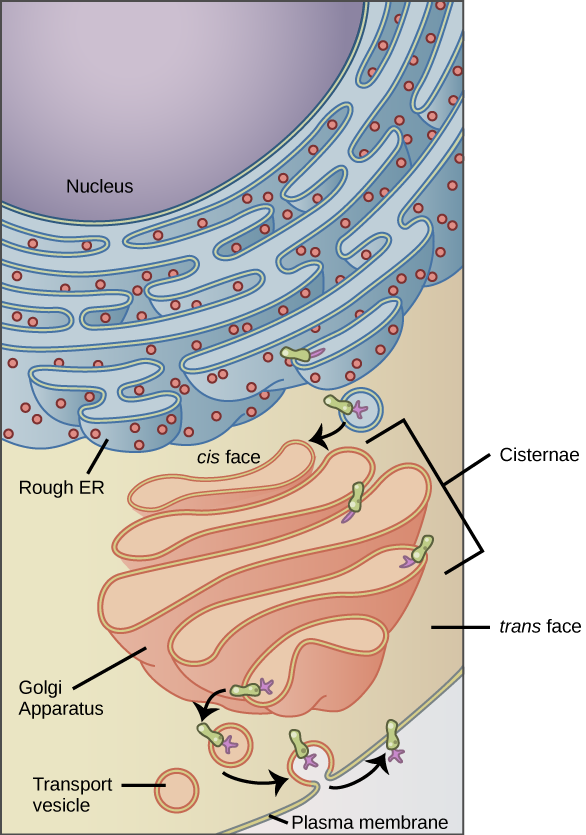
 

endomembrane system
Figure 1 Membrane and secretory proteins are synthesized in the rough endoplasmic reticulum (RER). The RER also sometimes modifies proteins. In this illustration, a (green) integral membrane protein in the ER is modified by attachment of a (purple) carbohydrate. Vesicles with the integral protein bud from the ER and fuse with the cis face of the Golgi apparatus. As the protein passes along the Golgi’s cisternae, it is further modified by the addition of more carbohydrates. After its synthesis is complete, it exits as integral membrane protein of the vesicle that bud from the Golgi’s trans face and when the vesicle fuses with the cell membrane the protein becomes integral portion of that cell membrane. The smooth ER is also a part of the endomembrane system, but is not involved in protein synthesis and is not shown in this figure. (credit: modification of work by Magnus Manske)


References

Unless otherwise noted, images on this page are licensed under CC-BY 4.0 by OpenStax.

Text adapted from: OpenStax, Concepts of Biology. OpenStax CNX. May 18, 2016 http://cnx.org/contents/b3c1e1d2-839c-42b0-a314-e119a8aafbdd@9.10

Image Descriptions

Figure 1 description

The image shows the components of the endomembrane system inside a eukaryotic cell. Each of the structures described below is surrounded by a double line, representing the phospholipid bilayer. At the center is the nucleus, drawn as a large purple circle enclosed in a double membrane. Connected to the nucleus is the endoplasmic reticulum (ER), which appears as a network of folded membranes that look something like a maze. The rough ER has small red circles on it representing ribosomes. Vesicles, which are colored circles suurrounded by a line representing the membrane, are shown budding off from the ER and moving to the Golgi apparatus, which is drawn as a series of flattened, curved sacs. The Golgi further ships vesicles to other parts of the cell. Lysosomes and vacuoles are shown as separate membrane-bound sacs that receive and break down materials. The cell membrane forms the outer boundary of the cell, and arrows indicate the flow of materials between these structures. This diagram highlights how membranes and transport vesicles work together to move proteins and other molecules through the cell.

License

Icon for the Creative Commons Attribution 4.0 International License

MHCC Biology 112: Biology for Health Professions Copyright © 2019 by Lisa Bartee is licensed under a Creative Commons Attribution 4.0 International License, except where otherwise noted.

Share This Book