
41 Genes Direct the Production of Proteins
Most genes contain the information needed to make functional molecules called proteins. A few genes produce other molecules that help the cell assemble proteins. The journey from gene to protein is complex and tightly controlled within each cell. It consists of two major steps: transcription and translation. Together, transcription and translation are known as gene expression.
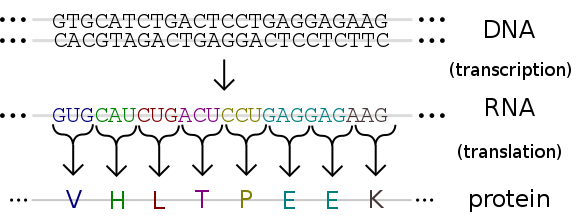
During the process of transcription, the information stored in a gene’s DNA is transferred to a similar molecule called RNA (ribonucleic acid) in the cell nucleus. Both RNA and DNA are made up of a chain of nucleotide bases, but they have slightly different chemical properties. The type of RNA that contains the information for making a protein is called messenger RNA (mRNA) because it carries the information, or message, from the DNA out of the nucleus into the cytoplasm.
Translation, the second step in getting from a gene to a protein, takes place in the cytoplasm. The mRNA interacts with a specialized complex called a ribosome, which “reads” the sequence of mRNA bases. Each sequence of three bases, called a codon, usually codes for one particular amino acid. Remember that amino acids are the building blocks of proteins. A type of RNA called transfer RNA (tRNA) assembles the protein, one amino acid at a time. Protein assembly continues until the ribosome encounters a “stop” codon (a sequence of three bases that does not code for an amino acid).
Following this process, the genetic information stored in the DNA is copied into an mRNA molecule, which is then used to assemble the amino acids into the correct order to make a protein. The order of amino acids determines the shape of the protein (through the four levels of protein structure described in the Protein chapter), and the shape of a protein determines its function. This means that the order of nucleotides in the DNA determines how proteins function, which is what determines an organism’s traits.
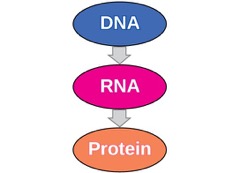
The flow of information from DNA to RNA to proteins is one of the fundamental principles of molecular biology. It is so important that it is sometimes called the “central dogma.”
Video Transcript
In this BioCAST, we’re going to answer the question, “What is the central dogma of biology?”
The central dogma of biology is the process by which information flows in living cells. The instructions in DNA are converted into a functional protein product. The central dogma of biology explains the flow of genetic information from DNA to RNA to making a functional product: a protein.
This idea was first proposed in 1957 by Francis Crick shortly after he and James Watson discovered the structure of DNA. The central dogma suggests that in living cells, DNA contains the information needed to make all of the cell’s proteins, and that RNA is the messenger that carries this information to the ribosomes.
We can think of the cell as a protein-producing factory, and the ribosome functioning as the specific protein-building department.
The process by which the DNA instructions are converted into a functional protein product is called gene expression. Gene expression has two key stages: transcription and translation. In transcription, the information in the DNA is converted into a small portable RNA message called messenger RNA or mRNA. During translation, these mRNA messages travel from inside the cell nucleus out to the ribosomes in the cytoplasm, where they are read to make specific proteins.
The central dogma states that the pattern of information that occurs most frequently in cells is from existing DNA to new DNA, which is called DNA replication; from DNA to make new RNA, which is called transcription; and from RNA to make new proteins, which is called translation.
Reverse transcription is the transfer of information from RNA to make new DNA. This occurs in the case of retro viruses such as HIV. It is the process by which genetic information from RNA is assembled into new DNA.
Does the central dogma always apply? With modern research, it’s becoming clear that some aspects of the central dogma are not entirely accurate. Current research is focusing on investigating the function of non-coding RNA. Although this does not follow the central dogma, it still has a functional role in the cell.
In summary, the central dogma of biology is the unifying theme that we see in all living organisms where DNA makes RNA and RNA makes protein.
Thanks for viewing this BioCAST. Don’t forget to like, comment, and subscribe. Don’t forget to check us out on the web at www.biocast.com.
References
Unless otherwise noted, images on this page are licensed under CC-BY 4.0 by OpenStax.
“What are proteins and what do they do?” by U.S. National Library of Medicine is in the Public Domain.