"

87 Pedigrees and Punnett Squares

Pedigrees

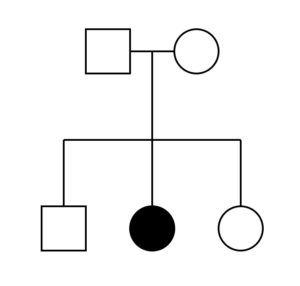
Inheritance of a trait through generations can be shown visually using a pedigree, such as is pictured in Figure 87.1. Square shapes represent males; circles represent females. Filled-in shapes are individuals that have whatever trait is being shown in the pedigree. Two individuals connected together with a horizontal line between them are the parents of the individuals that are connected by vertical lines below them. Siblings are typically shown in birth order with the oldest sibling to the left.
11d.simplepedigree
Figure 87.1. A simple pedigree. In this pedigree, the parents (at the top) have produced three children: a male and two females. The first female has the condition being shown in the pedigree.
Figure 87.1 Image Description

A simple pedigree is shown. An open square representing a man without the trait being analyzed is connected with a horizontal line to an open circle, representing a woman without the trait. A vertical line goes down from the middle of the horizontal line. A horizontal line intersects this vertical line. There are three vertical lines down from this horizontal line. At the bottom of the first vertical line is an open square (man without the trait). At the bottom of the second vertical line is a filled-in circle (woman with the trait). At the bottom of the third vertical line is an open circle (woman without the trait).


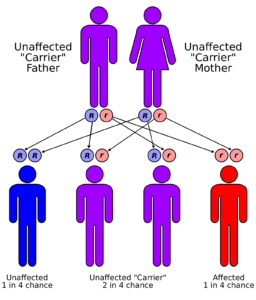
As discussed above, diploid individuals have two copies of each chromosome: one from their male parent, one from their female parent. This means they have two copies of each gene. They can have two of the same alleles (homozygous) or two different alleles (heterozygous). Regardless of their genotype, they will pass one copy of each chromosome to their offspring. This is because meiosis produces haploid gametes that contain one copy of each chromosome. Since genes are present on chromosomes, this means they will pass one copy of each gene to their offspring. That means that an offspring inherits one allele of each gene from each of its two parents. This is illustrated in Figure 87.2.

allele inheritance
Figure 87.2. Two parents who are heterozygous each pass one chromosome / gene / allele to each offspring. Each resulting offspring has two of each chromosome / gene. The individual can have two of the same or two different alleles.


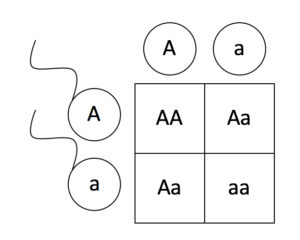
An easy, organized way of illustrating the offspring that can result from two specific parents is to use a Punnett square. The gametes that can be generated by each parent are represented above the rows and next to the columns of the square. Each gamete is haploid for the “A gene”, meaning it only contains one copy of that gene. In the Punnett square seen in Figure 5, haploid eggs are above each column and haploid sperm are next to each row. When a haploid sperm and a haploid egg (each with 1 copy of the “A gene”) combine during the process of fertilization, a diploid offspring (with 2 copies of the A gene) is the result.
11e.punnetsquareex
Figure 87.3. A Punnett square showing a cross between two individuals who are both heterozygous for A.
Figure 87.3 Image Description

A Punnett square is constructed using a box with 4 quadrants. Above each column is a circle representing an egg. One egg is labeled with a capital A and the second is labeled with a little a. Next to each row are circles with tails representing sperm. One sperm is labeled with a capital A and the second is labeled with a little a. Inside the quadrants of the square are the results of fertilization events between the egg above that column and the sperm next to that row. The upper left quadrant is labeled AA (capital A capital A), upper right is Aa (capital A lower case a), lower left is Aa (capital A lower case a), lower right is aa (lower case a lower case a).

A Punnett square shows the probability of an offspring with a given genotype resulting from a cross. It does not show actual offspring. For example, the Punnett square in Figure 87.3 shows that there is a 25% chance that a homozygous recessive offspring will result from the cross Aa x Aa. It does not mean that these parents must have 4 offspring and that they will have the ratio 1 AA : 2 Aa : 1 aa. It’s just like flipping a coin: you expect 50% heads, but you wouldn’t be too surprised to see 7 heads out of 10 coin flips. Additionally, the probability does not change for successive offspring. The probability that the first offspring will have the genotype “aa” is 25% and the probability of the second offspring having the genotype “aa” is still 25%. Again, it’s just like flipping a coin: if you flip heads the first time, that doesn’t change the probability of getting heads on the next flip.


Video Transcript

A Punnett square is often used to better understand the patterns of inheritance associated with Mendelian genetics.

Remember that each parent in a genetic cross is diploid, meaning that they have two copies of each trait. During meiosis, these traits separate into individual gametes, either egg or sperm cells.

In a Punnett square, the outside of the square represents the possible gametes that may be produced by each parent. In our example, a plant that is heterozygous for flower color produces gametes that either have the purple, or big P allele, or the white, or little p, allele. The area within the Punnett square represents the possible zygotes, or offspring produced by the combination of a specific egg or sperm cell. Note that we cannot predict which egg cell will be fertilized by which sperm cell, so a Punnett square indicates all of the possible combinations.

A Punnett square not only allows us to visualize the potential offspring from a cross, but also allows us to calculate the probability of obtaining an offspring with a specific phenotype or genotype. Notice that, assuming both parents are heterozygous, that there is a 3/4 chance that the offspring will have the dominant purple phenotype, and a 1/4 chance that the offspring will be white.

Punnett squares are useful for quickly visualizing the results of a single-trait or two-trait cross.

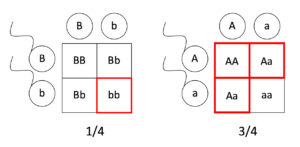
Organisms don’t just inherit one trait at a time, though. They inherit all their traits at once. Sometimes, we want to determine the probability of an individual inheriting two different traits. The easiest way to do this is to determine the probability of the individual inheriting each trait separately, then multiply those probabilities together. An example of this can be seen in Figure 87.4.

11e.abpunnett
Figure 87.4. These two Punnett square show the cross between two individuals who are both heterozygous for two different genes: BbAa x BbAa. We can determine the probability of an offspring having the recessive trait for “B” and the dominant trait for “A”. The probability of the offspring having the recessive phenotype for “B” is 1/4. The probability of the offspring having the dominant phenotype for “A” is 3/4. 1/4 x 3/4 = 3/16.

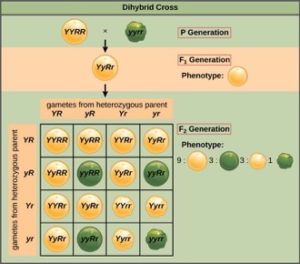
Another way of determining the probability of getting two different traits is to use a dihybrid Punnett square. Figure 87.5 shows three generations of the inheritance of pea seed color and shape. Peas can be either yellow or green, and they can be either round or wrinkled. These are two of the traits that Mendel studied in his work with peas. In the first generation (the “P” generation), two true-breeding (homozygous) individuals are crossed. Their offspring will get one allele of the Y gene and one allele of the R gene from each parent. This means that all their offspring (the “F1” generation) will be heterozygous for both genes. The results (the “F2” generation) from crossing two heterozygous individuals can be seen in the 4×4 Punnett square in Figure 87.5.

10j.dihybrid
Figure 87.5. This dihybrid cross shows the expected offspring from the F2 generation after crossing YYRR x yyrr. Compare the results from this Punnett square to the results seen in the previous figure. They match!
Figure 87.5 Image Description

A dihybrid Punnett square is constructed using a box with 16 quadrants. Above each column are the haploid gametes produced by one parent. Next to each row are the haploid gametes produced by the second parent. In this specific dihybrid cross, the two parents had genotypes of YYRR and yyrr. The YYRR parent has both dominant genotypes: round seed shape and yellow seed color. The yyrr parent has both recessive genotypes: wrinkled seed shape and green seed color. If those two parents were crossed, all the offspring would have the genotype YyRr and the dominant phenotype for both traits (round and yellow). An individual with the genotype YyRr can produce 4 different gametes: YR, Yr, yR, and yr. Two parents with the same genotype are shown in this punnett square. Like in a monohybrid punnett square, the two gametes combine and the resulting offsprings genotype is shown in the box in the punnett square. For example, when a YR and a YR gamete combine, the resulting offspring has the genotype YYRR. When a Yr and a yR gamete combine, the resulting offspring has the genotype YyRr. The results of this dihybrid cross are 9 round yellow offspring, 3 round green offspring, 3 wrinkled yellow offspring, and one wrinkled green offspring.

The gametes produced by the F1 individuals must have one allele from each of the two genes. For example, a gamete could get an R allele for the seed shape gene and either a Y or a y allele for the seed color gene. It cannot get both an R and an r allele; each gamete can have only one allele per gene. The law of independent assortment states that a gamete into which an r allele is sorted would be equally likely to contain either a Y or a y allele. Thus, there are four equally likely gametes that can be formed when the RrYy heterozygote is self-crossed, as follows: RY, rY, Ry, and ry. Arranging these gametes along the top and left of a 4 × 4 Punnett square (Figure 87.5) gives us 16 equally likely genotypic combinations. From these genotypes, we find a phenotypic ratio of 9 round–yellow:3 round–green:3 wrinkled–yellow:1 wrinkled–green (Figure 87.5). These are the offspring ratios we would expect, assuming we performed the crosses with a large enough sample size.

We can look for individuals who have the recessive phenotype for Y and the dominant phenotype for R. These individuals must have two little y’s and at least one big R. The possible genotypes are yyRR or yyRr. Examining the Punnett square in Figure 87.5, we can find 3 individuals with these genotypes (they are round and green). If you compare the results from Figure 6 and Figure 87.5, you’ll see that we have arrived at the same value: 3/16!

Video Transcript

A dihybrid cross illustrates the potential results from crossing individuals that differ in regard to two traits.

In this case, the Parents, or P generation, differ in both pea color and shape. A plant homozygous for wrinkled green peas is crossed with a plant homozygous for round yellow peas. Because both parents are homozygous for both traits, only gametes coding for wrinkled green peas or gametes coding for round yellow peas are produced.

A diagram of the cross between two members of the F1 generation, called a “Punnett square,” is shown here. When the gametes from these pea plants are combined, all of the offspring in the F1 generation are round and yellow. This is because the traits for round and yellow are dominant over the traits for green and wrinkled.

Because all offspring within the F1 generation are heterozygous for both traits, both the males and females can produce four different gamete combinations: round yellow peas, wrinkled yellow peas, round green peas, and wrinkled green peas.

A Punnett square is created to determine the F2 generation that results from this cross. Of the offspring produced within the F2 generation, 9 are round yellow peas, 3 are round green peas, 3 are wrinkled yellow peas, and 1 is a wrinkled green pea. In other words, a 9:3:3:1 ratio exists within the F2 generation.

Mendel was able to use this observation to determine that factors assort independently of other pairs of factors. This has become known as the law of independent assortment.


License

Icon for the Creative Commons Attribution 4.0 International License

MHCC Biology 112: Biology for Health Professions Copyright © 2019 by Lisa Bartee is licensed under a Creative Commons Attribution 4.0 International License, except where otherwise noted.

Share This Book