
87 Black fur color: a dominant trait
Black fur color is dominant over brown
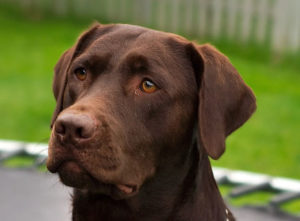
Most of us are familiar with the labrador retriever dog breed, such as the chocolate lab seen in Figure 8. But have you ever thought about what makes this dog brown? The difference between brown and black coat color in dogs is caused by a mutation in the TYRP1 gene. The TYRP1 gene provides instructions for making an enzyme called tyrosinase-related protein 1. This enzyme is required to produce a pigment called eumelanin. Eumelanin is a dark colored pigment.
The TYRP1 gene is located on chromosome 11 in dogs (Parker, 2001).
A group of scientists who were interested in determining what caused the difference between black and brown coats sequenced the DNA within the protein-coding region of the TYRP1 gene (Schmutz, 2002). They identified three variations in the DNA making up the TYRP1 gene between brown dogs and black dogs. These variations in DNA sequence are examples of different alleles of the TYRP1 gene.
Table 1: Variations in the TYRP1 allele that lead to brown color in dogs. Data from Schmutz, 2002.
| Location | Black DNA sequence | Brown DNA sequence | Effect on protein |
| exon 2 | TGT | CGT | changes a cysteine amino acid to a serine |
| exon 5 | CAG | TAG | introduces a premature stop codon which results in 330 amino acids instead of 512 amino acids in the protein |
| exon 5 | CCT | — (deleted) | deletion of a proline amino acid |
All of these variations in the DNA sequence are predicted to cause a change in the amino acid sequence of the TYRP1 protein. These changes affect the production of eumelanin pigment, which is black in color. When eumelanin is not being produced correctly, the dog appears brown instead of black.
Like other diploid organisms, dogs all have two copies of the TYRP1 gene (one from their male parent, one from their female parent). Dogs that are homozygous for the black allele (dogs that have two copies of the black allele) are obviously going to be black in color. Dogs that are homozygous for the brown allele are obviously going to be brown. Dogs that are heterozygous (dogs that have one black allele and one brown allele) appear black. The black and brown colors do not blend together: the black allele covers up the brown allele. This means that the black allele is dominant over the brown allele. Remember that dominant alleles cover up recessive alleles. If there is one dominant allele present, the dog will appear black. The brown allele is recessive to the black allele. There must be two copies of the recessive brown allele present in order for the dog to appear brown.
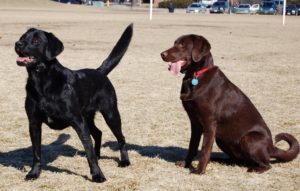
Remember that genotypes can be abbreviated with a single letter and that the letter which is chosen is typically the first letter of the dominant trait. In this case, the letter “B” is used to represent the dominant black allele, while “b” represents a recessive brown allele.
The reason that the black allele is dominant over the brown allele in this specific situation is because the black allele produces functional TYRP1 protein, while the brown allele does not. The presence of one functional allele produces enough TYRP1 protein allows the cells to produce eumelanin and appear black.
Remember: dominant does not mean “better” or “more normal”. Black color does not confer any special advantages on dogs compared to brown color. It’s just a difference.
Let’s visualize the inheritance of black and brown using a pedigree. The pedigree in Figure 11 shows a litter of puppies. The shaded symbol shows a brown puppy, while open symbols are black individuals.
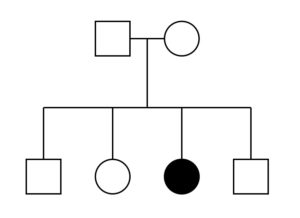
To interpret this pedigree, let’s start with information that we already know:
- Brown is recessive, which means brown individuals must have the genotype bb. In this pedigree, brown individuals are filled in.
- Black is dominant, which means black individuals must have at least one B allele. Their genotype could be either BB or Bb. In this pedigree, black individuals are not filled in.
Figure 12 shows the same pedigree, but with information about the individual’s genotypes filled in.
- The shaded individual, who is a brown female puppy, must have the genotype bb. If she had any B alleles, she would be black because the black allele is dominant over the brown allele.
- In order for the brown puppy to have the genotype bb, she must have gotten two “b” alleles: one from each of her parents. We know that her parents are both black (because they are unshaded), which means they must have a least one “B” allele. This means that both parents must be heterozygous: Bb.
- The three black puppies must have at least one “B” allele in order for them to be black in color. However, we can’t tell whether they are homozygous dominant (BB) or heterozygous (Bb) since both of those genotypes would result in black color. One way to represent this on a pedigree is B-, meaning that the second allele could be either B or b.
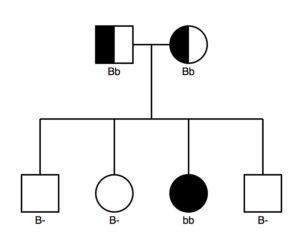
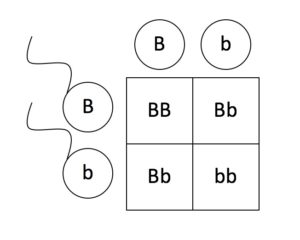
We can also show the cross between these parents as a Punnett square (Figure 13). We would expect 1/4 of the offspring to have the genotype bb, and that is what we see in the pedigree above.
Human Connection
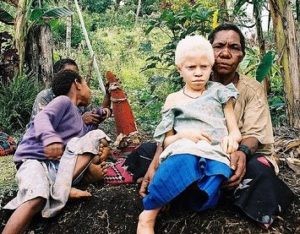
A small number of mutations in the TYRP1 gene have been found to cause oculocutaneous albinism type 3. This condition includes a form of albinism called rufous oculocutaneous albinism, which has been described primarily in dark-skinned people from southern Africa. Affected individuals have reddish-brown skin, ginger or red hair, and hazel or brown irises. Two TYRP1 mutations are known to cause this form of albinism in individuals from Africa. One mutation replaces a protein building block (amino acid) in tyrosine-related protein 1 with a signal that prematurely stops protein production. This mutation, written as Ser166Ter or S166X, affects the amino acid serine at protein position 166. The other mutation, written as 368delA, deletes a single DNA building block from the TYRP1 gene. Other alterations in this gene have been reported in a few affected people of non-African heritage. Most TYRP1 mutations lead to the production of an abnormally short, nonfunctional version of tyrosinase-related protein 1. Because this enzyme plays a role in normal pigmentation, its loss leads to the changes in skin, hair, and eye coloration that are characteristic of oculocutaneous albinism.
References
Unless otherwise noted, images on this page are licensed under CC-BY 4.0 by OpenStax.
Parker HG, Yuhua X, Mellersh CS, Khan S, Shibuya H, Johnson GS, Ostrander EA. Sept 2001. Meiotic linkage mapping of 52 genes onto the canine map does not identify significant levels of microrearrangement. Mamm Genome. 12(9):713-8.
Schmutz SM, Berryere TG, Goldfinch AD. 2002. TYRP1 and MC1R genotypes and their effects on coat color in dogs. Mammalian Genome 13, 380-387.
OpenStax, Biology. OpenStax CNX. May 27, 2016 http://cnx.org/contents/s8Hh0oOc@9.10:FtsD6vMd@3/Mendels-Experiments
OpenStax, Biology. OpenStax CNX. May 27, 2016 http://cnx.org/contents/s8Hh0oOc@9.10:sbdXt0s3@4/Laws-of-Inheritance
Information about TYRP1 and oculocutaneous albinism type 3: “Tyrp1” by Genetics Home Reference: Your Guide to Understanding Genetic Conditions, National Institutes of Health: U.S> National Library of Medicine is in the Public Domain