
"

78 Passive Transport: Osmosis

Osmosis is the diffusion of water through a semipermeable membrane according to the concentration gradient of water across the membrane. Whereas diffusion transports material across membranes and within cells, osmosis transports only water across a membrane and the membrane limits the diffusion of solutes in the water. Osmosis is a special case of diffusion. Water, like other substances, moves from an area of higher concentration to one of lower concentration. Imagine a beaker with a semipermeable membrane, separating the two sides or halves (Figure 78.1). On both sides of the membrane, the water level is the same, but there are different concentrations on each side of a dissolved substance, or solute, that cannot cross the membrane. If the volume of the water is the same, but the concentrations of solute are different, then there are also different concentrations of water, the solvent, on either side of the membrane.
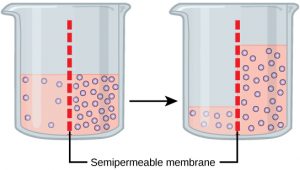
osmosis through a semipermeable membrane
Figure 78.1. In osmosis, water always moves from an area of higher concentration (of water) to one of lower concentration (of water). In this system, the solute cannot pass through the selectively permeable membrane.

A principle of diffusion is that the molecules move around and will spread evenly throughout the medium if they can. However, only the material capable of getting through the membrane will diffuse through it. In this example, the solute cannot diffuse through the membrane, but the water can. Water has a concentration gradient in this system. Therefore, water will diffuse down its concentration gradient, crossing the membrane to the side where it is less concentrated. This diffusion of water through the membrane— osmosis —will continue until the concentration gradient of water goes to zero. Osmosis proceeds constantly in living systems.

Tonicity

Tonicity describes the amount of solute in a solution. The measure of the tonicity of a solution, or the total amount of solutes dissolved in a specific amount of solution, is called its osmolarity. Three terms—hypotonic, isotonic, and hypertonic—are used to relate the osmolarity of a cell to the osmolarity of the extracellular fluid that contains the cells. All three of these terms are a comparisonbetween two different solutions (for example, inside a cell compared to outside the cell).

In a hypotonic solution, such as tap water, the extracellular fluid has a lower concentration of solutes than the fluid inside the cell, and water enters the cell. (In living systems, the point of reference is always the cytoplasm, so the prefix hypo– means that the extracellular fluid has a lower concentration of solutes, or a lower osmolarity, than the cell cytoplasm.) It also means that the extracellular fluid has a higher concentration of water than does the cell. In this situation, water will follow its concentration gradient and enter the cell. This may cause an animal cell to burst, or lyse.

In a hypertonic solution (the prefix hyper– refers to the extracellular fluid having a higher concentration of solutes than the cell’s cytoplasm), the fluid contains less water than the cell does, such as seawater. Because the cell has a lower concentration of solutes, the water will leave the cell. In effect, the solute is drawing the water out of the cell. This may cause an animal cell to shrivel, or crenate.

In an isotonic solution, the extracellular fluid has the same osmolarity as the cell. If the concentration of solutes of the cell matches that of the extracellular fluid, there will be no net movement of water into or out of the cell. The cell will retain its “normal” appearance. Blood cells in hypertonic, isotonic, and hypotonic solutions take on characteristic appearances (Figure 78.2).

Remember that all three of these terms are comparisonsbetween two solutions (i.e. inside and outside the cell). A solution can’t be hypotonic, that would be like saying that Bob is taller. That doesn’t make sense – you need to say that Bob is taller than Mike. You can say that the solution inside the cell is hypotonic to the solution outside the cell. That also means that the solution outside is hypertonic to the solution inside (just like Mike would be shorter than Bob).
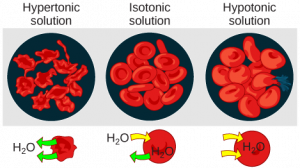
figure_03_21 osmosis in red blood cells
Figure 78.2 Osmotic pressure changes the shape of red blood cells in hypertonic, isotonic, and hypotonic solutions. (credit: modification of work by Mariana Ruiz Villarreal)
Figure 78.2 Image Description

The image compares how red blood cells look in three different solutions based on the concentration of solutes outside the cell. It is divided into three circular panels labeled Hypertonic solution, Isotonic solution, and Hypotonic solution. In the hypertonic solution panel on the left, the red blood cells appear shrunken and wrinkled. Water molecules (depicted by arrows) are shown moving out of the cells, making them lose volume. In the isotonic solution panel in the middle, the red blood cells are shown as normal, round cells. Water moves into and out of the cells equally, so their shape stays unchanged. In the hypotonic solution panel on the right, the red blood cells are swollen and enlarged because water moves into the cells. These shapes are smoother and fuller than in the isotonic condition. Arrows beneath each panel illustrate the direction of water movement relative to each cell type: out of the cell in hypertonic, balanced in isotonic, and into the cell in hypotonic.

Some organisms, such as plants, fungi, bacteria, and some protists, have cell wallsthat surround the plasma membrane and prevent cell lysis. The plasma membrane can only expand to the limit of the cell wall, so the cell will not lyse. In fact, the cytoplasm in plants is always slightly hypertonic compared to the cellular environment, and water will always enter the plant cell if water is available. This influx of water produces turgor pressure, which stiffens the cell walls of the plant (Figure 78.3). In nonwoody plants, turgor pressure supports the plant. If the plant cells become hypertonic, as occurs in drought or if a plant is not watered adequately, water will leave the cell. Plants lose turgor pressure in this condition and wilt.
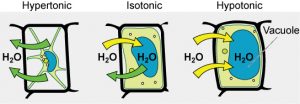
figure_03_22-1 turgor pressure
Figure 78.3. The turgor pressure within a plant cell depends on the tonicity of the solution that it is bathed in. (credit: modification of work by Mariana Ruiz Villarreal)
Figure 78.3 Image Description

The image compares how plant cells look in three different solutions based on the concentration of solutes outside the cell. It is divided into three panels labeled Hypertonic, Isotonic, and Hypotonic. In the isotonic solution panel in the middle, the plant cell is shown as a normal, rectangular cell with a cell wall on the outside, a cell membrane filled with cytoplasm and a large internal vacuole filled with water. Water moves into and out of the cells equally, so their shape stays unchanged. In the hypertonic solution panel, the plant cell appears shrunken and wrinkled inside the cell wall (which remains in place). Water molecules (depicted by arrows) are shown moving out of the cell, making it lose volume. In the hypotonic solution panel, the plant cell is swollen and enlarged because water moves into the cells. The internal vacuole is larger than in the isotonic solution and the cell wall is bowed outwards because of the increased size of the vacuole.

Video Transcript

Here is the easiest way to remember what isotonic, hypotonic, and hypotonic means for nursing school. Seriously, you don’t want to miss this, all right?

So your body always wants to stay in balance, right? So if you don’t get enough sleep or don’t eat enough food, you get a little cranky, right? You’re out of balance. Well, the same thing goes for all of the cells in your body. They want to be in balance and there are two key factors at play here: water or fluid and solids.

So water, obviously, is water and solutes means all of those little particles floating around in the blood like sodium glucose and potassium. So let’s keep these two things in mind as we go through this. So your body cells need a proper balance of solutes and water. If there’s too much of one and not enough of the other, it’s out of balance, and the cells get very unhappy.

So the first fluid tenacity that we’re going to talk about is isotonic solutions. So isotonic solutions means that it’s in balance. Fluid in solutes aren’t shifting any which way inside or outside of the cells. When you think isotonic I want you to think, “‘I so’ want to stay here in balance.” So isotonic means, “I so” want to stay here. There’s a proper balance of water and solutes. There’s nothing shifting any which way. So when you give a solution that’s isotonic that fluid is going to stay where you put it. So remember “I so” want to stay here. It doesn’t cause fluid to shift inside or outside to the cells. It keeps the cells in balance.

Now let’s talk about hypotonic. When you think of hypotonic, I want you to think about little hippos. So from now on I’m going to call it high bow tonic – I’m actually gonna call it hippo tonic – because I want you to think of hypotonic cells as cute little hippos because they are big and round and bulky. They have a lot of fluid in them because here’s what’s happening in a hypotonic solution: There is a lot more water inside that solution compared to the solutes. So it’s really, really diluted and when a diluted solution encounters the cell, all of that extra water wants to move into the cell to restore balance. So cells want there to be a proper balance of water and solutes so when you add a lot of water or a diluted solution like a hypotonic solution, that water is going to move into the cell and make them look big, big, big and chunky like a hippo – so when you think hypotonic solution think hippo-tonic.

Now let’s talk about hypertonic solutions. So hypertonic makes the cells look like super hyper because they burned off all that energy and now it’s really itty itty itty bitty skinny – it shrinks. It was super hyper, it danced around everywhere, and now it’s lost all of that fluid and all of that weight and it’s a skinny little cell. So hypertonic solutions are filled with solutes. They have so many solutes compared to the water inside of it. When that super concentrated solution comes in contact with that cell, the cell says, “Oh, man, here! Have some water!” and gives all of its water away. It goes and dances around and loses all of its water – or at least that’s how I like to think about it as cells dancing around everywhere. So when you think of hypertonic think hyper, as in the cell we’re super hyper, and it danced around everywhere and lost all of its water weight. It gave it all of its water away.

So if this was a super helpful explanation for you and you want more videos like this one, write love in the comments below and subscribe to this channel so you don’t miss out on any other nursing school tips or tricks that we’ve got coming up for you. Now if you need more help with learning fluid and electrolytes in nursing school you will definitely want to jump into the nursing SOS membership community where of course we have a whole fluid and electrolytes course to help you learn all about these things for a nursing school. Now click on the next video we’ve got for you to help you rock nursing school and become the nurse that God created only you to be. I will see you over there.

References

Unless otherwise noted, images on this page are licensed under CC-BY 4.0 by OpenStax.

Text adapted from: OpenStax, Concepts of Biology. OpenStax CNX. May 18, 2016. http://cnx.org/contents/b3c1e1d2-839c-42b0-a314-e119a8aafbdd@9.10

License

Icon for the Creative Commons Attribution 4.0 International License

MHCC Biology 112: Biology for Health Professions Copyright © 2019 by Lisa Bartee is licensed under a Creative Commons Attribution 4.0 International License, except where otherwise noted.

Share This Book